Grouville

Grouville

Grouville is in the east of Jersey and is dominated by the broad sweep of the Royal Bay of Grouville. The parish covers a surface area of 4,354 vergees. It borders Saint Clement, Saint Saviour and Saint Martin

History
The parish of Grouville shares, with the neighbouring parish of Saint Martin, a dedication to Saint Martin of Tours. The ecclesiastical parish and parish church are dedicated to "Saint Martin de Grouville" to distinguish them from the parish of Saint Martin (historically 'Saint Martin le Vieux'). The Church of St Peter la Rocque was built in the 19th century.
The name 'Grouville' may derive from:
- the small community established in what is now the parish by St Gerou (also known as Gervold or Geraldius), an ecclesiastical troubleshooter in the employ of Charlemagne in the 9th century AD;
- 'Gros Villa' (great farm)
- Geirr, the Viking leader after whom the Island may be named.
The Royal Bay of Grouville gained its royal epithet when it impressed Queen Victoria during her visit in 1846. The bay is popular with tourists for its broad sandy beach and shallow, warm water. It is also the main oyster producing area of Jersey, and was also formerly noted for the gathering of vraic (seaweed) for spreading on fields over the winter before planting potatoes the following year. Parishioners also used to burn vraic, giving rise to the traditional nickname of les Enfuntchis (the smoky ones, or the dim ones, in Jèrriais) shared by the Grouvillais and their neighbours in Saint Clement.
Inland, the parish is also home to Jersey's most noted archaeological site at La Hougue Bie, now a museum run by the Jersey Heritage Trust. A prehistoric artificial mound covers a passage grave aligned for the equinox. A mediaeval chapel, Notre Dame de la Clarté, built on the Neolithic mound, was converted in the 18th century to a folly-like residence, the Prince's Tower (demolished in the 1920s). During the Second World War, the occupying German forces constructed bunkers in and alongside the ancient mound, now also transformed for museum interpretation.
La Rocque was the site of the landing of the French forces on 6 January 1781. The skirmish at La Platte Rocque was ancillary to the Battle of Jersey.
The Royal Jersey Golf Club, Gorey Village, and Queen's Valley (now flooded to form a reservoir) are situated in the parish.
Vingtaines
Grouville is divided for administrative purposes into vingtaines as follows:
- Vingtaine des Marais
- Vingtaine de la Rue
- Vingtaine de Longueville
- Vingtaine de la Rocque
Grouville forms one electoral district and elects one Deputy.
The offshore islands, Les Minquiers, between Jersey and France, are part of the parish of Grouville.
Grouville features
Some of the important places in the parish
- Grouville Common
- Grouville Marsh
- Grouville Fountain
- Grouville School
- Marais à la Coque
- Route des Cotils
Twin towns
Grouville is twinned with:
- Portbail in France
Constables
Further article
Home for girls
In around 1854 Abraham Le Sueur, Rector of Grouville, founded a female orphans home. Inb 1862 the establishment, also known as the Home for Girls, moved into purpose-built premises on land opposite Grouville parish church.
At some date the home began to accept young boys with their older sisters. It continued in operation while the island was under German occupation during the Second World War. The home closed in 1959 and the girls were transferred to the Home for Boys, which became a mixed institution, subsequently renamed Haut de la Garenne.
Part of the Grouville premises were then used to rehouse the Junior Training Centre, formerly part of the Westaway Creche in St Helier.
The Grouville building was eventually demolished to make way for a housing estate


Gallery
Click on any image to see a full-size version
-
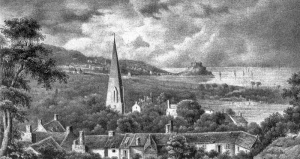 A view of Grouville from the parish church to Mont Orgueil Castle in the distance
 -
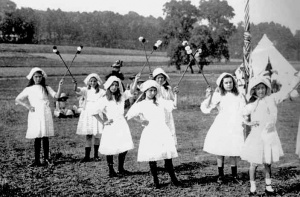 Traditional dancers at a Grouville ceremony
 -
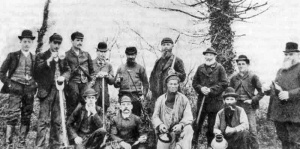 Grouville farmers
 -
 The fiefs of Grouville
 -
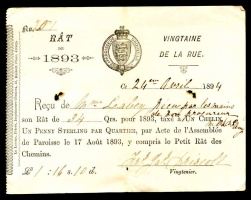 A parochial rate receipt
 -
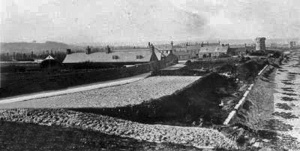 Grouville coastline
 -
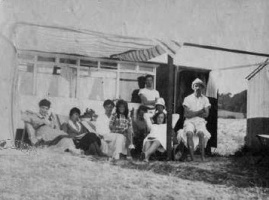 Weekend chalet on Grouville Common
 -
-
-
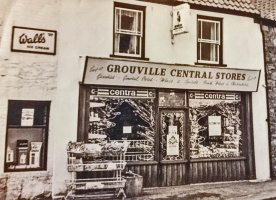
-
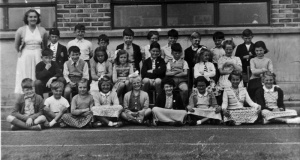 The parish chool in 1954
 -
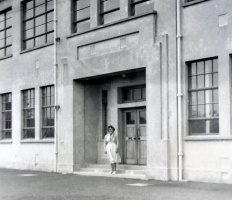 Miss Gibbons at Grouville School in 1953
 -
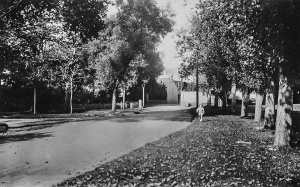
-

-
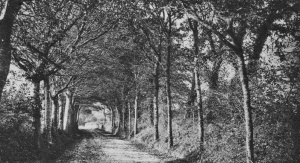 La Hougue Lane, 1903
 -
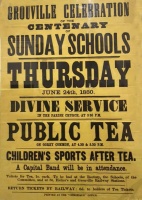 Poster for Sunday School celebrations
 -
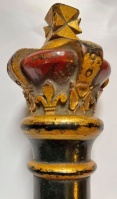 Grouville Centenier's baton de justice
 -
 Baton de justice
 -
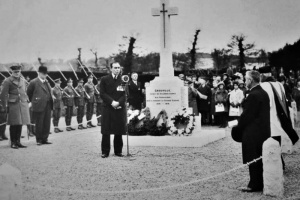 Unveiling ceremony of the parish war memorial
 -
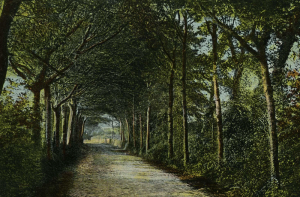 La Hougue
 -
![Grouville Common]]](/w/images/thumb/7/7e/1108-GrouvilleCommon.jpg/300px-1108-GrouvilleCommon.jpg) Grouville Common]]
Grouville Common]]


Lane1903.jpg)


![Grouville Common]]](/wiki/File:1108-GrouvilleCommon.jpg)

External links
Notes and references
- ↑ Combined offices of Jurat and Constable. Died 1537. Start and end dates uncertain
- ↑ Probably succeeded his father when he died, but no documentary proof of this
- ↑ Principal heir in 1547of Sire Philippe Jutize, priest, his brother
- ↑ Son of Charles. Lived near Hougue Bie. Died in office in 1558
- ↑ Probably the same as above. Died in office in 1571
- ↑ Died 1597
- ↑ Son of Clement. Constables could only remain in office for a year at this time. Stood again after death of successor in 1608
- ↑ Son of former Constable Martin Jutize, above. Died in office
- ↑ Second term. See above
- ↑ Son of Edouard. Constable and Procureur du bien Public at same time. Jurat in 1640. Lived atMaison des Pres
- ↑ Son of 1608 Constable Francois, above
- ↑ Seigneur of Ponterrin, elder son of Jean Payn, son of Anthoine, of Hougue Bie. Not closely related to Jean, previous Constable
- ↑ Second term. Resigned because of ill health after 15 months in office
- ↑ Royalist. Resigned with the arrival of Parliamentarians. Reinstalled at Restoration
- ↑ No record of swearing-in; Court rolls missing for 1651-1655. Younger brother of Helier, Constable of St Clement 1637. Died in office
- ↑ Resigned at Restoration
- ↑ First elected 1643-1651. Resigned under Parliamentary rule. Resigned again in 1663
- ↑ Younger son of Jurat Francois de Carteret, Seigneur of La Hague. Settled in Grouville after marriage to Marie Jutize, eldest daughter and principal heir of Edouard Jutize, son of Philippe, son of Edouard. Died 1687
- ↑ Previously Centenier. Resigned 1668. Younger son of Francois Amy, son of Francois, of Catillon de Bas, and Esther, nee Lempriere, daughter of Michel, Seigneur of Dielament. Lived at Pied de Catillon
- ↑ Died in office
- ↑ Second term. See above
- ↑ Younger son of Solicitor-General Jean Le Hardy. Suspended by Royal Court on 14 May 1691 for leaving the island without a passport from the Lieut-Governor. He did not attempt to excuse or justify himself and on 21 June 1692 the Court revoked his appointment and ordered a new election. He died in 1704
- ↑ Son of Josue, Constable in 1666. Died 1704
- ↑ Younger son of Jurat Benjamin Dumaresq and Elizabeth, nee De Carteret. Jurat 1711; died 1723
- ↑ Involved in a case before the Privy Council. As Chef de Charette on Fief de la Reine, he was exempted from the duty of supplying hay to the Receiver-General while he served as Constable. Queen's Sergeant Jean Filleul appealed to the Council, which overturned the Court's decision and required the Constable to perform the service in future. Resigned 1719
- ↑ Son of Charles. Jurat 1726
- ↑ Son of Francois. Resigned and discharged in 1731, but resumed office
- ↑ Died 1751
- ↑ Advocate 1726, deputy Attorney-General 1734. Died in office
- ↑ Owned and lived at Homestead. Died in office
- ↑ Died the year after he was elected. Son of Helier and direct descendant of Helier, Constable in 1663
- ↑ Son of Pierre, Constable in 1739, above. Denonciateur in 1734. Died in office 1764
- ↑ Son of predecessor Pierre. Only 22 when elected and died the following year
- ↑ Centenier before
- ↑ Second term. See above. Owner of La_Fontaine
- ↑ Second term
- ↑ Son of Pierre, who preceded him
- ↑ Third term
- ↑ Two terms. Grandson of Elie, Constable in 1741
- ↑ Second term
- ↑ Second term
- ↑ Second and third terms; died in office
- ↑ Son of Philippe, of La Pelotte, and Marie, nee Falle, daughter of Elie
- ↑ Probably son of earlier Constable Thomas, see above
- ↑ <Son of earlier Constable Elie, above
- ↑ Re-election in 1832 contested by Jean Falle. Simonet won by 102 votes to 91, but the result was challenged. Jean Falle withdrew his challenge in April 1833. Pierre Simonet was a tobacco importer
- ↑ Lived in Francheville area. Died 1847
- ↑ Jurat in 1854
- ↑ Died in 1881 at the age of 72. Parish deputy for seven years before Constable
- ↑ Solicitor of Royal Court, Deputy, then Constable. Died in office at the age of 47
- ↑ Younger son of Jean, of La Hougue, son of Jean, son of Elie