Jersey bonnets

Jersey bonnets

This Jersey sun bonnet, photographed by Edwin Dale, is as close to what is recognised as the standard design as any
The Jersey bonnet, or sun bonnet, to distinguish it from other types, has long disappeared from use, but was once recognised as a defining article of clothing, mainly in farming families. Jerripedia editor Mike Bisson, who lives in Normandy, where the Jersey bonnet may have originated, investigates their use in the island and compares them with their French 'cousins'.
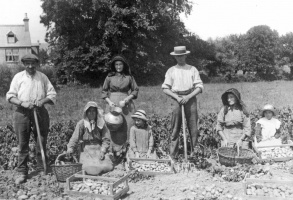
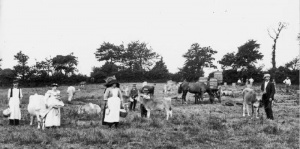
Sun bonnets are now worn almost exclusively by babies, but in the Victorian era, stretching into the early years of the 20th century, when farmers' wives and daughters would frequently be found working in the fields, they were worn by women of all ages.
Brittany and Normandy
Known also as the Jersey coiffe, they were not the same thing as the famous Breton coiffe. Still to be seen today when women dress in traditional costume for fetes, parades and other special occasions, the Breton coiffe is usually a delicate, lacy bonnet. Styles vary enormously and it is said that every town and village has its own unique pattern, some of them undeniably very beautiful.
The same cannot be said for Normandy, where many coiffes are remarkable for their size, rather than their beauty. And although some patterns are attributed to particular locations, others were worn (or still are) over a wider area. A search for a coiffe which is traditional to my closest town, Mortain, revealed just one, described as common to an area covering the whole of the south-west of the Manche department, as far as the border with Brittany at Pontorson, and Avranches on the coast.
A search for Vire, a short distance north in the Calvados department, revealed two very distinct styles, and for St Hilaire-du-Harcouet just to the south, revealed nothing except adverts for today's hairdressers.
I cannot recall the last time I saw a Normandy coiffe being worn, but they were frequently on display at village events and functions when I lived in Brittany some 25 years ago. But there seemed to be no consensus as to what was actually the accepted pattern for any location, and I remember good-natured debates between young ladies sporting dramatically different styles as to which was actually the 'real' one for the village.

Jersey
Jersey does not appear to have any tradition of coiffes of its own to be worn on special occasions, and although farmworkers from Brittany and Normandy brought theirs with them and regularly wore them when the congregated in Hilgrove Street, known as 'French Lane' on their days off.
It is doubtful, though, that there is any connection between the coiffes worn as part of a traditional costume and the sun bonnets worn by islanders and their French labourers while working in the fields. Indeed, it has been suggested that the Jersey sun bonnet which was popular in the 19th and early 20th centuries, was of no great antiquity, and far from being of French origin, was brought to the island from England.
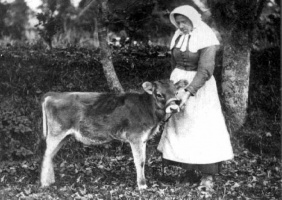
It was not designed with beauty in mind, but was a purely functional garment designed to protect the wearer from the sun's rays, while the men wore flat caps.
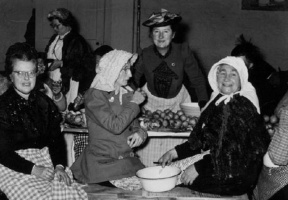
The sun bonnet was built over a structure of canes which supported its shape, and was then tied with a ribbon under the chin. Many who wore them found this somewhat claustrophobic and left the bonnet open. Some bonnets had a cloth extension beneath to cover the shoulders. Others, of a similar shape, could be folded flat, leading to the name 'concertina bonnet'.
Colour
The majority of the evidence for the type of bonnets which were worn comes from black and white photographs and postcards, so it is difficult to be certain what colour the coiffes were, but it seems likely that they were white, balck, and perhaps light grey.
Black coiffes were traditionally worn for funerals in Brittany, but we have found no confirmation that the same was the case in Jersey.
The traditional shape of Jersey bonnet seems not to have been looked on as a fashion item, but it was very common for ladies having their photograph taken by a professional photographer to were a more delicate bonnet, although there does not seem to be any consistency of pattern.
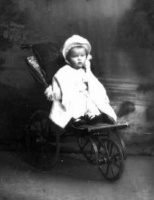
Babies had their white bonnets, and children of various ages would often be photographed wearing one, as evidenced by the delightful photograph of Brighton Road infants below.


-
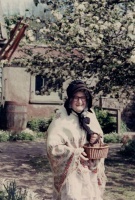 Alicia Godfray photographed at Paul Mill by Marguerite Hamilton
 -
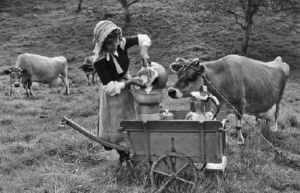
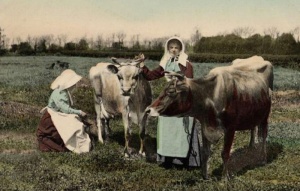
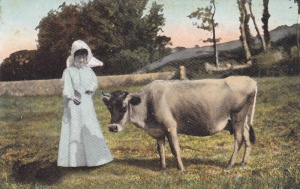
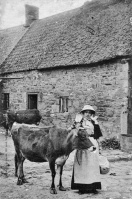 This milkmaid in a Jersey farmyard was wearing a very stiff type of bonnet with none of the pleats of the more traditional variety
 -
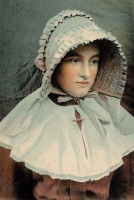 From an LL tinted postcard
 -
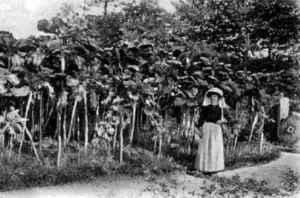
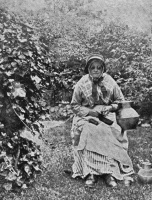 This lady was clearly determined that the rays of the sun would not reach an inch of her body
 -
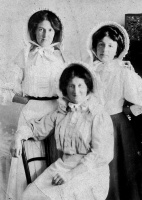 A mother and two daughters wearing matching bonnets, probably for the garden rather than for farm work
 -
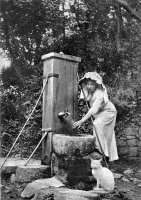 A young lady wearing an untied, pleated bonnet
 -
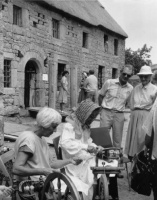 Re-creation of a Jersey scene, complete with bonnets, at Hamptonne in 1990
 -
-
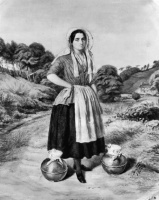
-
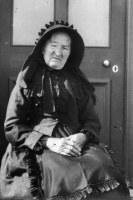 A Francis de Faye portrait
 -
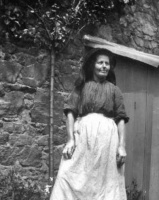 A Francis de Faye portrait
 -
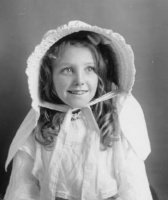 A Francis Foot photograph, probably of his daughter
 -
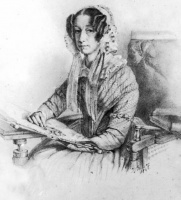 Harriet Le Couteur
 -
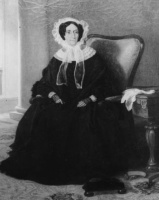 Harriet Le Couteur
 -
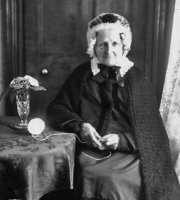 A C P Ouless photograph
 -
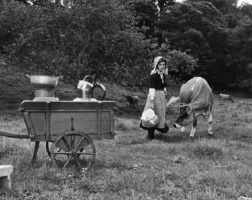
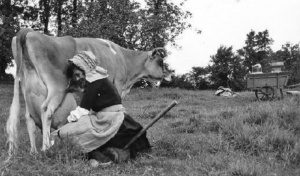
 Sophie Allix (1886-1942) and her cousin Mary Ann Billot, dressed ready for milking in a field
 -
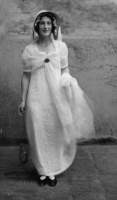 Miss Beazley
 -
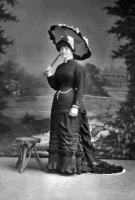 Miss De Ste Croix in 1880, photographed by Baudoux
 -
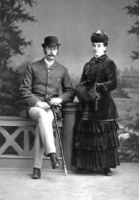 Mr and Mrs Beakbane
 -
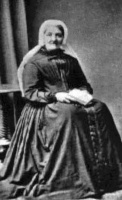 Mrs Amy
 -
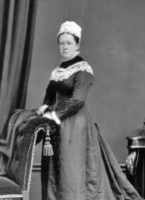 Mrs Angier
 -
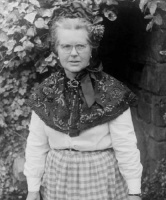 Mrs B de Veulle, Societe Jersiaise Librarian
 -
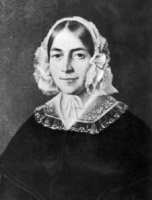 Ms Corbet Le Breton in 1846
 -
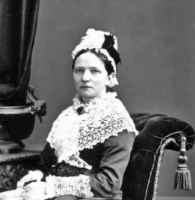 Mrs Cross, photographed by Baudaux
 -
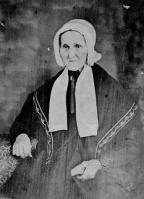 Mrs de Carteret
 -
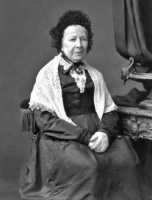 Mrs Finlay
 -
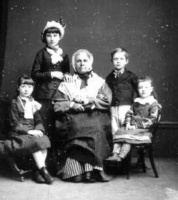 Mrs Pacquet
 -
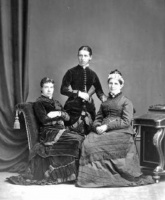 Mrs Prime and her children
 -
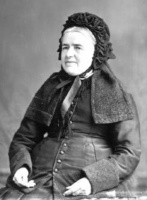 Mrs Rive
 -
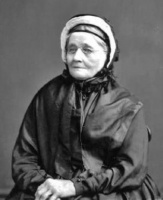 A Baudoux portrait from the late 1870s
 -

-
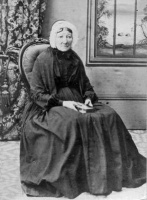 A portrait by Joshua Picot
 -
-
-
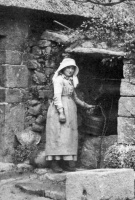 Rozel Cottage
 -
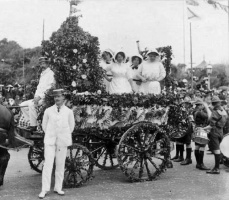
-
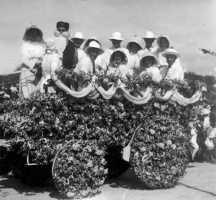
-
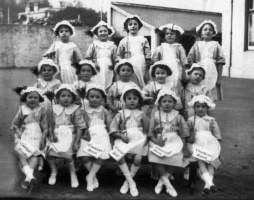 Brighton Road Infants, 1913
 -
-
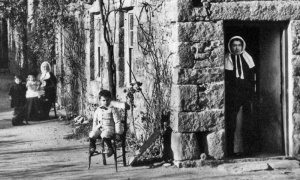 Brook Farm, St Brelade
 -
-
-
-
-
-
-
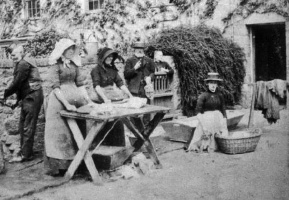 The Gaudin family's Green Farm laundry
 -
-
-
-
-
-
-
-
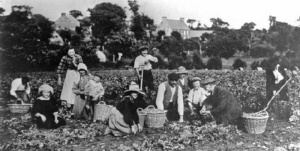
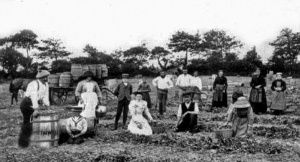
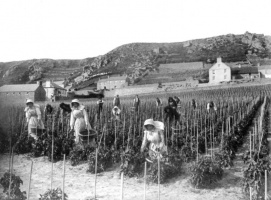 Picking tomatoes at L'Etacq
 -


.jpg)
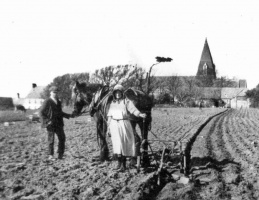
DiggingBonnets.jpg)


Breton and Normandy coiffes


-
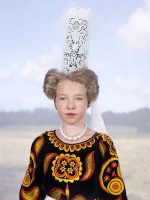 Pont Aven, Brittany
 -
 Pont Aven
 -
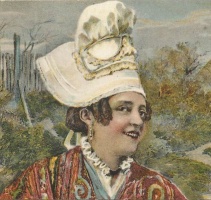 Bayeux, Normandy
 -
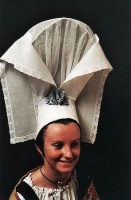 Caen, Normandy
 -
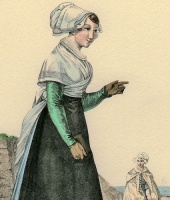 Granville, Normandy
 -
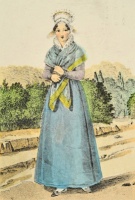 South-west Manche, Normandy
 -
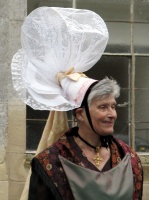 Normandy
 -
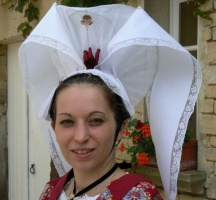 Normandy
 -
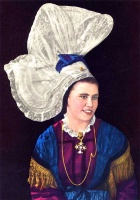 Normandy
 -
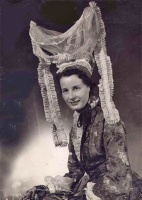 Normandy
 -
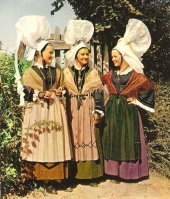 Normandy
 -
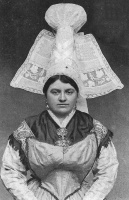 Papillon d'Avranches, Normandy