La Collette tower

La Collette Tower

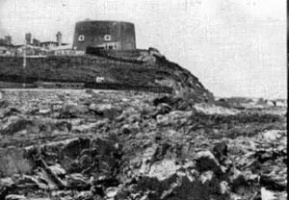
This tower, also known as Pointe des Pas, was conceived as a communication link between Fort Regent and Elizabeth Castle, and also gave protection to the approach to the early elements of St Helier Harbour and the coastline eastwards from Havre des Pas. It was constructed about 1834 in the Martello style

HER entry
Along with all Jersey's other coastal towers and historic fortifications it is a listed building, described as follows in the Jersey Heritage Historic Environment Record website:
A rare survival of a late 18th century Engineers barracks with 1830s Martello tower of the highest standards of military design and construction of the period. Of significance as an integral part of a group of military defences in Jersey that illustrates the changing political and strategic military history of the island in the late 18th and early 19th centuries through to the second world war.
The Board of Ordnance assumed responsibility for the defences on the east, south and south-west coast; and the States of Jersey took responsibility for those on the west, north-west and north coast. The States of Jersey ordered that work commence on the construction of new coastal defences on 3 March 1832 and a series of towers of the English Martello pattern was built, the last of such defence positions to be erected in the British Isles.
A three-gun tower - La Collette at Pointe des Pas - was completed in 1834 to cover the headland, primarily to defend the Havre des Pas area beneath the flank of Fort Regent. It was built on the site of the former guardhouse.
La Collette Tower is a fine example of the largest, English east-coast pattern Martello - designed primarily for mounting artillery on a roof platform. It is cam-shaped in plan with a characteristic squat and robust profile - the tower measuring approximately 56 ft in diameter and 33 ft in height.
It has noticeably battered, very thick, outer walls of exposed Jersey granite (originally rendered) with very few openings - limited to small windows lighting the upper accommodation level and a raised first floor entrance - the original doorway (with name of King William above) facing away from the direction of attack and with a specially profiled threshold to enable an entrance ladder to be withdrawn. Another ground floor doorway was inserted at a later date.

The roof deck was originally designed to mount three guns, with a very broad encircling parapet wall - subsequently capped with modified access. Access to roof level was designed via a pair of granite stairs set entirely within the thickness of the external wall.
The roof platform is supported off the central pillar and brick vault below. The tower is arranged internally on three levels. At ground floor was the original magazine, designed with no external openings except for small baffled ventilation slots and only accessible via an internal stair from the first floor. The first floor is designed as a bomb-proof vault protecting the accommodation for gunners. The walls are large blocks of ashlar granite with a central dressed granite pillar and impressive brick vaulting supporting the gun platform above.
Set within the outer wall is a circuit of deep-set windows dressed with ashlar granite, and originally 2 fireplaces - one large to serve the main room, and a smaller version presumably to serve a smaller sectioned off area for officers. The 1834 entrance door is located on the landward side of the room.
-
-
 1939
1939 -
 A view across Havre des Pas with La Collette tower in the distance on the far left
 -

-

-

-


-
 German RN Sud 1 fortification close by
 -
 RN Sud 1
 -
 RN Sud 1